
The Ferrari
Legend: Built on
Fire, Speed
& Billions.
Maranello, Italy · Est. 1947 · NYSE: RACE
Some brands sell cars.
Ferrari sells a religion.
For almost 80 years, the Prancing Horse has been the world’s most powerful symbol of speed, desire, and the human obsession with perfection. Behind the glossy red paint and the thunder of a V12 engine lies a story that does not begin on a showroom floor — but on a grimy Italian racetrack, with one obstinate, visionary man who refused to be told what was impossible.
And that story has become one of the most extraordinary financial empires the modern world has ever produced.
The Man Who
Started It All
Enzo Ferrari was born on February 18, 1898, in the town of Modena, Italy. Since his childhood, he was obsessed with speed. After years as a driver and racing manager at Alfa Romeo in the 1920s and 1930s, an explosive falling-out made him walk away entirely. His exit contract barred him from using the Ferrari name for four years. He spent those years silently building his vision. The moment that promise expired, he unleashed it on the world.
The story of Ferrari officially begins in 1947 — when the first car ever built under the Ferrari marque, the 125 S, drove through the historic factory gates on Via Abetone Inferiore in Maranello. It was a machine built purely for racing. It was nearly unbeatable from the start. The legend was born — with zero advertising, zero showrooms, and a budget barely sufficient to cover the fuel.
The 1950s & 60s:
Racing as Religion
By the 1950s and 1960s, Ferrari was the undisputed ruler of motorsport. The team won the 24 Hours of Le Mans in 1949, and in 1950 Ferrari entered Formula 1 — becoming the only brand to have competed in every single F1 season since the championship began.
The 250 GTO. The Testarossa. The F40. Each era produced machines that were not merely fast — they were sculpture. Pininfarina’s studios gave Ferrari its visual language: long hoods, sculpted haunches, a silhouette so recognisable that a child could identify one from a kilometre away.
The 1960s delivered the defining rivalry with Ford. In 1963, Henry Ford II attempted to buy Ferrari and failed. He commissioned the GT40 with the express purpose of humiliating the Italians at Le Mans. He succeeded in 1966. Enzo was furious. Ferrari hit back. Their war remains one of the greatest stories in the history of sport.
“To secure capital and finance his racing dreams, Enzo sold half of Ferrari to Fiat in 1969. It was a calculated trade — financial security in exchange for partial independence. But the soul of the company remained entirely his.”
Enzo Ferrari died on August 14, 1988, at the age of 90. His death solidified the Ferrari myth, boosted sales further, and elevated the brand’s value beyond anything he had imagined. He never lived to see how far his obsession would travel.
The Schumacher Era:
World Conquest
After Enzo’s passing, Luca di Montezemolo was brought in as Chairman in 1991 to rescue a company in poor financial health. A renaissance followed. Michael Schumacher won the World Drivers’ Championship four consecutive times between 2000 and 2004, and Ferrari secured the Constructors’ title for five straight years from 1999 to 2004.
It was the most dominant era in Formula 1 history. It transformed Ferrari from a beloved Italian niche brand into a worldwide cultural phenomenon — referenced in rap songs, Hollywood films, and the fantasies of children on every continent.
Going Public:
Worth Billions
In October 2015, Ferrari was listed on the New York Stock Exchange under the ticker symbol RACE. It was a moment that baffled financial analysts — a company selling fewer than 8,000 cars annually commanding valuations that left mass manufacturers speechless. The market instantly grasped what accountants struggled to measure: Ferrari’s value was not in its volume. It was in its myth.
Ferrari’s market cap has grown from $8.90 billion in January 2016 to over $56 billion — a compound annual growth rate of nearly 20%. At its 2024 peak, Ferrari’s market capitalisation touched approximately $91 billion, making it one of the most valuable automotive companies per unit sold anywhere in the world.
The Numbers That
Defy All Logic
The financial story of Ferrari is unlike anything in the automotive industry. In 2024, net revenues reached an all-time high of €6,677 million — an 11.8% year-on-year increase. Cars and spare parts generated €5,728 million, while sponsorship and brand revenues rose 17.1% to €670 million.
Ferrari posted a net profit of €1.53 billion for full-year 2024 — a 21% increase from the previous year. EBITDA reached €2.56 billion with a margin of 38.3%. For context, most car manufacturers operate on margins of 5–10%. Ferrari runs at nearly four times that.
In 2024, Ferrari shipped just 13,752 cars — a 1% volume increase — yet revenues grew nearly 12%. This is entirely intentional. CEO Benedetto Vigna has been categorical: the strategy is quality of revenues over volumes. Fewer cars. More personalisation. Higher margins. The waiting list for most Ferrari models stretches years, not months.
Ferrari’s 2025 annual revenue reached $8.085 billion — a further 11.9% increase. As of March 2026, the net worth of Ferrari stands at approximately $91.88 billion. This is a company that deliberately restricts itself to producing around 14,000 vehicles per year. Toyota produces that many in a single day.
Le Mans, Endurance
& The Electric Future
On the racetrack, the comeback has been extraordinary. The Ferrari 499P won on debut at the 2023 24 Hours of Le Mans, ending Toyota’s five-year winning streak. Ferrari then repeated the feat at the 2024 24 Hours of Le Mans — its first back-to-back victory at the race since 1965. In 2025, Ferrari secured both the Manufacturers’ and Drivers’ titles in the FIA World Endurance Championship.
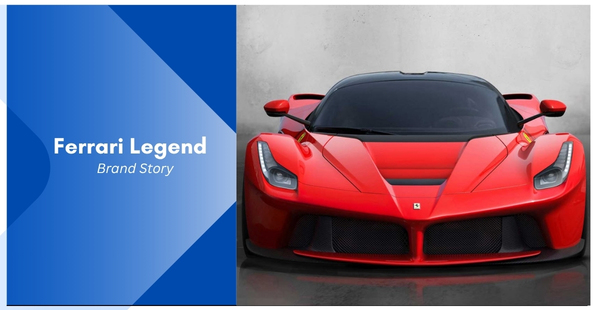
On the road, the evolution has been equally bold. The SF90 Stradale became Ferrari’s first plug-in hybrid production car. The Purosangue — Ferrari’s first four-door model — broke every rule the brand had written for itself, then sold out instantly. The F80 hypercar arrived in 2024 as the spiritual successor to the LaFerrari. And in October 2025, Ferrari unveiled its first fully electric vehicle: the Luce — promising 0–62 mph faster than any Ferrari V12 before it.
By 2026, Ferrari targets a product portfolio of 60% hybrid and full-electric models alongside 40% internal combustion engines, with 15 new models launched between 2023 and 2026.
“The Prancing Horse
never walks. It runs.”
“With one eye, we look at the past. With another, we look at the future. Innovation and tradition must coexist so that the DNA of the company can evolve through history.”
— Benedetto Vigna, CEO, Ferrari N.V.The paradox of Ferrari: a company born from the stubbornness of a man from Modena who simply refused to lose — now worth nearly $92 billion, generating $8 billion in annual revenues, conquering Le Mans, preparing for an electric future, and still making every driver feel exactly what Enzo felt in 1923.
Alive. Free. Faster than the rest of the world.